Showing posts with label Kansai. Show all posts

August 23, 2012

Kit Kats in Japan: A Journey

As a chocoholic, one of my main goals in Japan was to collect as many Kit Kats as possible. In New Zealand, we just have the standard milk chocolate, caramel, and cookies 'n cream chocolate bars. But I had fond memories of enjoying green tea, apple and strawberry flavoured Kit Kats during my time as an exchange student in Hiroshima, and I knew there were many more out there, with new seasonal and regional varieties being added each year.

Kit Kats are especially popular in Japan because the name 'Kit Kat' pronounced in Japanese sounds like 'Kitto Katsu', which roughly translates to 'certain win'. In this sense, Kit Kats have become an unusual good luck charm in Japan, particularly among students sitting exams who need a little bit of the old Nestle sweetness to help them towards a 'certain win'.
Green tea and vanilla
'Adult Sweetness' Raspberry
Over the course of five months, the Kit Kat collection became quite impressive indeed. Each Kit Kat came to have a story behind it - a memory of where, when and how it was obtained. A rainy day in Kyoto saw the procurement of Yatsuhashi cinnamon and Houjicha roasted tea flavoured Kit Kats, where the lady at the souvenir shop laughed and said 'foreigners love Kit Kats, don't they?'

On our trip to Miyajima, we had been disappointed because the famous floating torii had been under construction. The disappointment was quickly replaced by delight upon discovering a pack of Hiroshima Golden Citrus Kit Kats.

On the first day of summer, a reluctant visit to 7-Eleven to pay the bills resulted in the triumphant discovery of a new vanilla ice cream flavoured Kit Kat. I bought three packs, then had to get extra money out to pay the bills.
Yatsuhashi cinnamon and Houjicha roasted tea
Golden Citrus Blend
Vanilla ice cream
News quickly spread of the Kit Kat collecting mission, and soon I was bombarded with advice by Japanese friends and fellow exchange students - where to go to buy them, what flavours to look out for. I remember on a group trip to Nara, a Japanese friend gallantly went into souvenir shops asking on my behalf if they stocked any special Nara Kit Kats. It had turned into a highly competitive treasure hunt, with everyone wanting to bask in the Kit Kat glory. No expense was too great: 1050 yen, or about $16, was recklessly spent on a box of Rilakkuma hotcake flavoured Kit Kats, which came in a big fancy box, but only contained 12 little chocolate bars...
Rilakkuma hot cake
Part of the final collection
I didn't eat any of my Kit Kats until a couple of weeks before I left Japan. They were too precious, like little edible relics of my life in Japan. Then I realised they weren't going to all fit in my luggage, so I thought, bugger it, and we ended up eating most of the five months worth of Kit Kats in one night. I thought I would never be able to eat another Kit Kat again. But alas, guess what my last purchase in Japan was - at Kansai International Airport, past immigration, in the Duty Free shopping area, using my last remaining yen. Yup. Kit Kats.
Sakura green tea and 'peace' strawberry, packed into hand luggage
Blueberry cheesecake... also packed into hand luggage

July 01, 2012

Favourite Japan Foods: Purin (custard pudding)

Eating purin (プリン) is what it must feel like to bite into an angel. There is no better pleasure than to sink your spoon into the sweet, wobbly custard, ensuring in the process you also scrape up a little of the slightly bitter caramel sauce that has collected at the bottom, and let it slither around your mouth so you can savour the texture and flavour. Purin is essentially just creme caramel, and can be found pre-packaged almost anywhere in Japan - supermarkets, convenience stores, train stations. A small cup of purin costs around 100 yen, which is a fantastic deal, considering we are biting into angels here.
Kandai Purin
Kansai University's cafeteria is known for its special homemade Purin, called 'Kandai Purin'. Differences to store-bought Purin include a dollop of whipped cream on top, a firmer 'shell' of caramel sauce, a smoother, creamier texture, and a noticeable addition of love and care in the making of it. It is so popular that several batches are required over one lunch period, and every time a fresh batch of Purin is put out (about once every 15 minutes), the lunch ladies will ring a bell, initiating a frantic Purin riot.
Puchin Purin Mushi Pan
I have recently discovered a new bread at my local Lawson convenience store that has turned into something of a love affair. It's called 'Puchin Purin Mushi Pan, and consists of soft, steamed, caramel flavoured bread (more of a cake than bread, really), with a surprise filling of custard. Purin in cake form is all right by me.
Kobe Purin KitKats
On a recent trip to Kobe, we picked up this cute box of specialty KitKats, which are Kobe Purin flavoured - Kobe is very famous for its Purin. I have been very restrained and have not opened them yet, as we have been collecting various Japan KitKat flavours that I will sample and review in a later post... but I can already tell that these Purin ones are going to be my favourite.

June 22, 2012

Osaka Rainy Blues

Welcome to the midst of the rainy season, and one of the wettest weeks I've experienced yet in Osaka. I have spent the past few days daydreaming about a pair of overpriced, polka dot gumboots that are sitting tantalizingly in the window of a nearby shop. But then if I succumb to the gumboots, I will need a new umbrella to match (my current one is about the same colour bright pink as a 1980s aerobics leotard). Rainy season = fashion crisis.

Osaka experienced the tail end of a typhoon on Tuesday, which didn't end up being as exciting as it sounds. I went to class at 9 in the morning, as usual, and by lunchtime we were told that university was cancelled for the afternoon due to the weather warnings. A lot of the shops around Kandai-mae boarded up their doors and closed for the day, too, but all it amounted to was a little bit of thunder, a little bit of wind, and quite a lot of rain. This was good for the pathetic little river that runs past our apartment - we call it 'Vom Canal', because every Friday night there are always inebriated Japanese students vomiting into it. It's nice to see it flowing with actual water, and not regurgitated ramen, for once.

There is one reason to love the rain though, and that is okonomiyaki. One of my favourite restaurants in Kandai-mae is an okonomiyaki shop called 'Kyabetsu' ('cabbage'), and every time you go they give you a coupon that offers 50 yen off next time, and 100 yen off if it's a rainy day. I get excited over bargains. Especially weather themed ones.
Kyabetsu coupons to save for a rainy day.
Kyabetsu in Kandai-mae.
I know what you're thinking. "She's managed to turn this post into something about food... again." But when it's grey, damp and miserable outside, there's nothing better than seeking refuge in this cozy little shop, planting yourself in front of the heated tabletop, and being served up a hearty feast of savoury pancake goodness... that you know is gonna be 100 yen cheaper than usual. That's how you survive the Osaka rainy blues.

June 16, 2012

Robot Experiment

Yesterday a group of us exchange students were lucky enough to get the chance to participate in a robot experiment at Kansai University. It was my first time ever seeing a robot, and it was awesome getting an insight into the workings of the science and technology that Japan is so famous for.
First we had to fill out some paperwork, and then we were taken through the process of what the robot would do, and how we should react. We were taken into a room filled with people and cameras, which was quite intimidating. The first experiment involved the little green robot in the picture above (I thought it was really cute!). Images would come up on a screen, and the robot would tell us information about the image, and ask us questions about them. If we thought the robot was asking us the question, we would answer. The robot would then tell us if we were right or wrong. Afterwards we filled out a questionnaire about what we thought about the robot - like whether its gestures were natural and whether we thought it could potentially replace humans as a tour guide in a museum.
Next we were taken to a room that contained this charming 'maid' robot... so creepy. Before the experiment we were told that the robot would be carrying a tray of cookies, and in order to get a cookie, you had to put your hand up, and it would come to you. I didn't like the way she was dressed or the way she glided towards you me big staring eyes... but I liked the fact that she brought me cookies. Again, we filled in a survey about this robot, and used an iPad to do an exercise where we chose what eye shape looks the most friendly, I guess so they can try to make the robot look less creepy. We were talking to one of the researchers in charge of the experiment and she said the more human a robot looks, the scarier it is - which I think is quite true!

Japan technology is so crazy cool. Domo arigato Mr Roboto.

May 21, 2012

University life in Japan

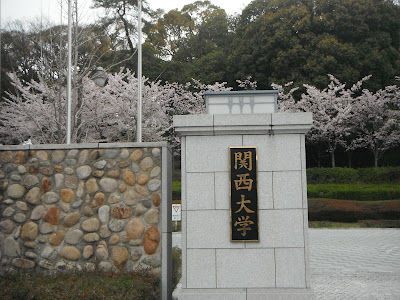
Kansai University
I post a lot about eating, drinking, shopping, sightseeing and partying in Japan, but barely anything about studying, as my parents have not-so-subtly pointed out on numerous occasions ('that all sounds lovely, but when do you have time to do your homework?'). I think I speak for most exchange students when I say, the actual 'study' part of the deal is not exactly the highest priority. And it shouldn't be. When I was figuring out my workload for this semester, even my course adviser said, 'you don't want to be spending all your time overseas stuck in the library.'

But there is no escaping the fact that classes and homework are a part of daily life while on exchange. And although I would rather spend my days visiting temples, castles and Sailor Moon cafes, university life in Japan still has its interesting points, and says something about Japan's education system.

At first I was worried university would be really difficult and strict here, because classes go for an hour and a half (as opposed to 50 minutes back home), and there are even classes on Saturdays. Then I got my timetable, and realised it wasn't going to be so bad after all. I have class Monday to Thursday, with just one class on Monday, and two on all the other days. You only need 7 credits (5 classes) to maintain your exchange student visa status, so I'm just doing the bare minimum.

I'm taking two advanced Japanese language classes - oral communication and literacy. The way these classes are taught is so different to the way I was taught Japanese back home. For one thing, instead of computers and PowerPoint, they still use blackboards and chalk here - in the land of electronics and gadgets, that was a big surprise. Also, there's a huge emphasis on rote learning. Every week we get tested on kanji and vocabulary that we're probably never going to use again (at least, I hope I'm not going to need to use 'cerebral apoplexy' again...). It all seems aimed at teaching us how to pass the Japanese Language Proficiency Test, which I'm not a big fan of. I just don't see how cramming a lot of pointless vocab measures proficiency.
Writing kanji over and over and over again...
Something else that's really different to back home is that you are graded on your attendance. For each of my classes, at least 30% of the final marks are based on attendance. Some classes make it a little bit more difficult by adding 'participation' into the mix, in order to target the students who come to class and sleep the whole way through it.. so essentially, 'participation' just means sitting up and looking perky.

The content of the lessons is always sort of strange, too. In Japanese class back home, our lecturer would always try and make each lesson topical and relevant, by teaching us about current issues in Japanese society. In Japanese class here, one of our reading topics was, 'are dolphins smart?' Hm.
Are dolphins smart? Am I smart enough to be learning about dolphins?
One good thing, though, is that the Japanese classes are actually taught entirely in Japanese, and you are expected to speak only in Japanese to the teacher and your classmates. This has been quite challenging, but it's been good to be immersed entirely in Japanese for at least an hour and a half a day. Being surrounded by English-speaking exchange students doesn't exactly encourage you to speak Japanese 24/7...

In addition to Japanese, I have 3 culture classes, which are taught in English (Politics, History, and Geisha culture) and are designed especially for exchange students. Again, the expectations for these classes don't seem to be that high. We have to do a presentation and a revision quiz for History, a presentation, 1500 word essay, and final exam for Politics, and just one final exam for Geisha culture.

Overall I think that university classes here are quite old fashioned in teaching style, and (dare I say?) much easier than back home. I think Japanese education puts too much emphasis on tests and exams, and not enough on critical, creative and independent thinking. From what I've seen/read/heard, in Japan, the high school years are actually more stressful and difficult than university - the complete opposite to New Zealand. Students spend their whole high school lives preparing to sit university entrance exams, particularly those for Japan's most prestigious universities. But once you've gotten into university, you're safe. Grades don't seem to matter to employers so much; just the fact that you got into that university is enough. So for a lot of university students in Japan, these years are a time to party and have fun.

Oh yeah, this post is dedicated to Matt, who wanted to know how academia in Japan differs to NZ. You nerd, you. =P

May 15, 2012

Summer Fashion in Japan

I have class at 9am every morning, and this is my typical routine: wake up at 8am, grab a pair of jeans and a t-shirt, slap on some make up, and check Facebook while eating breakfast. I leave my apartment at 8.45am, just as the Kandai-mae train pulls into the station, unloading about half of the student population. I join the mob of students, and we all snake our way up the hill to Kansai University.
Outside the Library at Kansai University
I always feel really inadequate during these daily walks to university. See, it's not like back home in New Zealand, where students wear leggings, puffer jackets and jandals to class (hell, I've seen people in pyjama pants). In Japan, university is the equivalent of a Nicki Minaj concert. Everyone looks fabulous. The walk up to Kandai is a sea of leather, lace and sequins - and that's just the boys!

I'm joking. Sort of. Japanese boys are noticeably fashion conscious. They will regularly wear suits to class, and snappy, expensive looking shoes. And the hair. We have a hair salon on campus, and I was in there one day waiting for Ryan to get his hair cut. There was a guy sitting next to me who had the most perfect locks I have ever seen. No idea why he needed to get his hair re-done. He kept fiddling with it as he waited, looking at himself adoringly in the mirror, tilting his head at different angles and making a pouty face. He was clearly obsessed, and I'm willing to bet he spends more time in that salon than in class.

It's the girls who really fascinate me. They get so dressed up for class. Almost all Japanese girls wear painful looking high heels to university each day. And when I say high heels, I mean sky-high stilettos that are made for clubbing. I just love the thought process behind these choices. 'Ooh, history class today... I know! I'll wear my Jimmy Choos.'

I'm quite happy wearing my converse sneakers. But if I wanted to, I could upsize to a scary looking platform sneaker. I'm having Spice Girl flashbacks so bad right now.

Summer trends in Japan are easy to pick up on, mainly because girls in Japan follow them religiously. Magazines just have to say the key word - for example, 'DENIM' - and suddenly, like magic, everyone is wearing something denim. Denim shirts, jackets and dresses are huge right now.


Another trend that a lot of Japanese girls are wearing are 'tattoo tights'. These are stockings that have tattoo designs on them so it looks like you have tattoos on your legs. Funky and rebellious!


Something interesting about summer fashion in Japan is that a lot of it is aimed at preventing exposure to the sun. While western countries find a suntan attractive, Japan (and Asia in general, I presume) see pale skin as highly desirable. Instead of fake tan, they sell skin whiteners. When it's a hot, sunny day, many women will actually carry umbrellas to shade themselves. I've even seen girls wearing face masks, the sort people wear when they have a cold, to hide their faces from the sun.

Surprisingly, one sun-smart accessory that hasn't caught on is sunglasses. I hardly ever see Japanese people wearing them. I asked my friend why, and he said sunglasses are seen as something that only 'Yakuza, rich people, and gaijin' wear. I wondered if I was being rude by wearing sunglasses, but my friend assured me no, I wasn't, but I was just acting like a stereotypical foreigner.

What a tourist.
I recently donned a pair of (ridiculously huge) sunglasses on a trip to Nara. It was a really sunny day, so I thought, why not. There were a lot of middle school students on a field trip in Nara that day, and my sunglasses became a topic of fascination. A group of boys came up to me, and one of them said 'Gaga, Gaga, I love you!' Then two groups of girls asked in giggly English if they could take photos with me. Oh, it was awkward. And I'm still not sure if being compared to Lady Gaga is a compliment. But hey. Sometimes it's fun to live the life of the rich and famous.

April 18, 2012

University Life in Japan: Clubs, Circles and Glow Sticks

Extracurricular activities are a huge part of Japanese school and university life. Most students will belong to a 'club' or 'circle'. The most common types of clubs and circles are typically sports, cultural activities, and foreign languages - probably similar to universities in most other countries. But clubs in Japan are intense. There is a Confucian value that dictates Japanese club culture called the senpai-kohai system - senpai essentially means 'senior', kohai is 'junior'. Until you've earned the title of 'senpai', you have to treat the senior members of the club like they are your masters. It's kind of like the relationship between Wormtail and Voldemort. (Did I really just compare Japanese society to Harry Potter? Too late, can't take it back now.)

 I
Kansai University Sakura tunnel with club and circle posters
On the first day of class at Kansai University, posters and mini-billboards advertising various clubs and circles appeared out of nowhere. Most appeared to have been made in an arts and crafts frenzy involving paint, paper collage, and a whole lot of glitter glue. The fun part is working out what some of the clubs even are - while a few have normal names (Rugby, Kendo, French), most have exotic names, for example, the 'Seahorse Club' (a swimming club... I guess that makes sense?), the 'Infinity Club' (a triathlon club... alright, maybe?), and my favourite, the 'Ducks Club' (English conversation club... nah, I don't get it.)


There were also cheerleaders holding tryouts, which I watched with great excitement (there are no cheerleaders in New Zealand). The Kansai University American Football team are called the Kaisers, and for a moment it looked as though all you had to do to join the squad was wave your pom poms and yell 'Let's go Kaisers!' in a slightly Japanese accent. I was just picturing myself sitting in Japanese class wearing a cute little cheerleader outfit, all ready to live out my Bring it On fantasy, when suddenly they started doing the most amazing lifts and flips and splits and tricks I have ever seen. Thus, the dream was short lived.

Kansai Kaisers Cheerleading Squad. So cute.

It is after class finishes, around about 6pm, that Kansai University really comes to life. Because this is when the meetings, activities, training sessions and practices for clubs and circles begin. Stroll through campus, and you can see the circus club juggling outside the library. The dance club rehearsing in the cafeteria entrance way. You can hear the roars of the Kendo and Naginata clubs coming from the martial arts centre. Peek into classrooms, and hear foreign language circles working on their Spanish and French pronunciation. And then, strangely, a chorus of loud screams and laughs coming from another classroom - a stress relief circle, possibly?

Last night we were walking through campus after dark, and came across a group of about a hundred students, sitting on the lawn, all wearing different coloured glow-in-the-dark bracelets and carrying glow sticks. Every now and then, some members would be chosen to stand up, and run away. A few moments later, other members would follow them into the darkness. What was this? Some sort of strange cult? Nope. It was an epic game of hide and seek tag. And this was a whole circle devoted to it. I just love how that would sound on a job application.
"What extracurricular activities were you involved in?"
"Hide and Seek tag."
"Very impressive! We'd love to have you as part of our team!"

As for me, as a result of my over-indulgence of melon pan over the past month, I have been considering joining the 'Belly Divas'. They are a belly dancing circle.

The Belly Divas.

April 11, 2012

Hanami Party: Chu-hi and Cherry Blossoms

Last night, a big group of us Kandai students made our way to Osaka Castle, carrying tarpaulin mats, beer, Chu-hi (cocktail in a can), vodka, snacks, bubbles, chocolate, cameras and card games. It was my first ever 'yozakura' (night cherry blossom) party. In somewhat related news, this morning also saw in my first ever Chu-hi related hangover.

Osaka Castle, lit up on a warm Spring evening
Hanami is serious business in Japan. To get the premium 'flower viewing' spots, it's not uncommon for employers to get their employees to sit outside for hours, holding down a space until the company's hanami party officially begins. As we left the Osaka Castle station exit, we even saw a man in a suit holding up a sign that said 'X Company's Hanami Party this way'. It's important to know exactly what patch of grass you will be occupying, and how to get there.


It's obvious what all the fuss is about. The cherry blossoms are painfully beautiful, and viewing them at night - yozakura - makes the experience all the more magical. The lights of the city and the lit-up castle acted as a backdrop for the frothy petals, and lanterns are strung between trees, so everything glows romantically. It's like being in a Miyazaki movie, or wandering in a very pink, candyfloss filled dream.
Food stalls!
Just as you thought I was getting all soppy and poetic, onto more important things: the grub. Everyone knows that at a hanami party, food and drink are almost more enjoyable than the actual cherry blossoms. Loud, garish food stalls line the path on the way to the castle, and the scents of fried noodles and octopus tentacles waft through the air, mingling with the perfume of the blossoms. I had takoyaki drenched in tangy sauce and sprinkled with seaweed flakes. Yum.

Chilling under a sakura tree.

The loud, crazy hanami party gang.
When we got to our spot, the drinks flowed, the snacks were devoured, and the conversation got slightly more frantic, as the alcohol consumption began to hinder our respective Japanese and English language skills. I personally suffered from a little too much liquid confidence in my own language ability, and found myself struggling to explain in Japanese the multiple meanings of 'perky nana'. (Which is first and foremost the name of a banana-flavoured chocolate bar in New Zealand).

I dressed up in florals with flowers in my hair for the occasion.
The sad thing about cherry blossoms is that they only last for a short time - maybe a week or two. Numerous haiku have been written using cherry blossoms as metaphors, for things that are beautiful but are gone too soon. I would like to take this opportunity to use cherry blossoms as a metaphor for the drinks at our Hanami party. They were also gone too soon.

Watch the video of our Hanami Party here!