Showing posts with label Exchange Student. Show all posts

February 28, 2013

The Only Blonde in Osaka: Where I've Been

Where I've been: 2012 Japan Trips
Today marks the one year anniversary of this blog! It began as a way of documenting my semester-long exchange at Kansai University in Osaka, Japan. I never thought anyone would actually read it. But along the way I started to really enjoy travel blogging. I started putting effort into my posts, hoping they might come in useful for anyone with an interest in Japan. I began reading other people's travel blogs, and was inspired by their style, tone, and all the fascinating places they were blogging about.

In the past year I have had more than 100,000 views on this blog, which is pretty cool. A lot of these are because I mention Sailor Moon so much that unwitting searchers probably think this is some sort of Sailor Moon fan site. Many views also come from the Japanese news website Searchina, which has a section reporting what foreign blogs are saying about Japan. Three of my posts have been translated and featured here. The views that make me happiest are from people who search 'Osaka blog' or 'things to do in Osaka'. I hope that they came to love Osaka as much as I did.

Glico Man: A symbol of Osaka
I think the best part about writing this blog has been that it encouraged me to do things I might not usually have done. I visited dodgy areas of Osaka. I ate and drank weird things. I used bizarre toilets. There was a brief sojourn to South Korea. I even went to a bloody baseball game. I would do pretty much anything for the sake of a story to put on my blog.

In December I was lucky enough to have another opportunity to go back to Japan, as part of the Kizuna Project. I spent 10 days in Japan examining the aftermath of the earthquake, tsunami and nuclear crisis. Visiting the Fukushima region gave me a whole new perspective of Japan. It was one of the best things I've ever done.
Kizuna Project: Asakusa on our last night in Tokyo
Where to now? I don't have any plans to go back to Japan in the immediate future. If I can save up enough money by the end of the year, I would love to go back - this time as a proper tourist, JR Rail pass and everything. I want to do the whole country, Okinawa to Hokkaido. Until then, I'm not entirely sure what to do with this blog. I may post every once in a while. For now, thank you to everyone for reading. Thank you to all my friends and fellow exchange students in Japan who made the experiences so special. Osaka - thank you for having me. お世話になりました.

Friends: A trip to Nara Park
I'll leave you with a motto that Ryan and I came up with after getting lost in Tokyo so many times during our first week in Japan. It stuck with us for the whole trip: "Even if it's the wrong way, it's an adventure.'
Ryan and Siobhan: Lost in Tokyo

May 21, 2012

University life in Japan

Kansai University
I post a lot about eating, drinking, shopping, sightseeing and partying in Japan, but barely anything about studying, as my parents have not-so-subtly pointed out on numerous occasions ('that all sounds lovely, but when do you have time to do your homework?'). I think I speak for most exchange students when I say, the actual 'study' part of the deal is not exactly the highest priority. And it shouldn't be. When I was figuring out my workload for this semester, even my course adviser said, 'you don't want to be spending all your time overseas stuck in the library.'

But there is no escaping the fact that classes and homework are a part of daily life while on exchange. And although I would rather spend my days visiting temples, castles and Sailor Moon cafes, university life in Japan still has its interesting points, and says something about Japan's education system.

At first I was worried university would be really difficult and strict here, because classes go for an hour and a half (as opposed to 50 minutes back home), and there are even classes on Saturdays. Then I got my timetable, and realised it wasn't going to be so bad after all. I have class Monday to Thursday, with just one class on Monday, and two on all the other days. You only need 7 credits (5 classes) to maintain your exchange student visa status, so I'm just doing the bare minimum.

I'm taking two advanced Japanese language classes - oral communication and literacy. The way these classes are taught is so different to the way I was taught Japanese back home. For one thing, instead of computers and PowerPoint, they still use blackboards and chalk here - in the land of electronics and gadgets, that was a big surprise. Also, there's a huge emphasis on rote learning. Every week we get tested on kanji and vocabulary that we're probably never going to use again (at least, I hope I'm not going to need to use 'cerebral apoplexy' again...). It all seems aimed at teaching us how to pass the Japanese Language Proficiency Test, which I'm not a big fan of. I just don't see how cramming a lot of pointless vocab measures proficiency.
Writing kanji over and over and over again...
Something else that's really different to back home is that you are graded on your attendance. For each of my classes, at least 30% of the final marks are based on attendance. Some classes make it a little bit more difficult by adding 'participation' into the mix, in order to target the students who come to class and sleep the whole way through it.. so essentially, 'participation' just means sitting up and looking perky.

The content of the lessons is always sort of strange, too. In Japanese class back home, our lecturer would always try and make each lesson topical and relevant, by teaching us about current issues in Japanese society. In Japanese class here, one of our reading topics was, 'are dolphins smart?' Hm.
Are dolphins smart? Am I smart enough to be learning about dolphins?
One good thing, though, is that the Japanese classes are actually taught entirely in Japanese, and you are expected to speak only in Japanese to the teacher and your classmates. This has been quite challenging, but it's been good to be immersed entirely in Japanese for at least an hour and a half a day. Being surrounded by English-speaking exchange students doesn't exactly encourage you to speak Japanese 24/7...

In addition to Japanese, I have 3 culture classes, which are taught in English (Politics, History, and Geisha culture) and are designed especially for exchange students. Again, the expectations for these classes don't seem to be that high. We have to do a presentation and a revision quiz for History, a presentation, 1500 word essay, and final exam for Politics, and just one final exam for Geisha culture.

Overall I think that university classes here are quite old fashioned in teaching style, and (dare I say?) much easier than back home. I think Japanese education puts too much emphasis on tests and exams, and not enough on critical, creative and independent thinking. From what I've seen/read/heard, in Japan, the high school years are actually more stressful and difficult than university - the complete opposite to New Zealand. Students spend their whole high school lives preparing to sit university entrance exams, particularly those for Japan's most prestigious universities. But once you've gotten into university, you're safe. Grades don't seem to matter to employers so much; just the fact that you got into that university is enough. So for a lot of university students in Japan, these years are a time to party and have fun.

Oh yeah, this post is dedicated to Matt, who wanted to know how academia in Japan differs to NZ. You nerd, you. =P

April 18, 2012

University Life in Japan: Clubs, Circles and Glow Sticks

Extracurricular activities are a huge part of Japanese school and university life. Most students will belong to a 'club' or 'circle'. The most common types of clubs and circles are typically sports, cultural activities, and foreign languages - probably similar to universities in most other countries. But clubs in Japan are intense. There is a Confucian value that dictates Japanese club culture called the senpai-kohai system - senpai essentially means 'senior', kohai is 'junior'. Until you've earned the title of 'senpai', you have to treat the senior members of the club like they are your masters. It's kind of like the relationship between Wormtail and Voldemort. (Did I really just compare Japanese society to Harry Potter? Too late, can't take it back now.)

 I
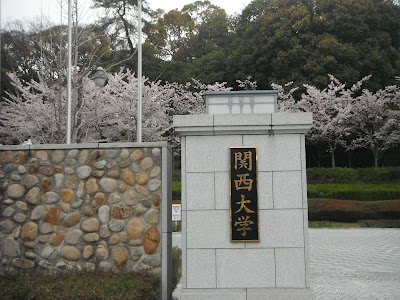
Kansai University Sakura tunnel with club and circle posters
On the first day of class at Kansai University, posters and mini-billboards advertising various clubs and circles appeared out of nowhere. Most appeared to have been made in an arts and crafts frenzy involving paint, paper collage, and a whole lot of glitter glue. The fun part is working out what some of the clubs even are - while a few have normal names (Rugby, Kendo, French), most have exotic names, for example, the 'Seahorse Club' (a swimming club... I guess that makes sense?), the 'Infinity Club' (a triathlon club... alright, maybe?), and my favourite, the 'Ducks Club' (English conversation club... nah, I don't get it.)


There were also cheerleaders holding tryouts, which I watched with great excitement (there are no cheerleaders in New Zealand). The Kansai University American Football team are called the Kaisers, and for a moment it looked as though all you had to do to join the squad was wave your pom poms and yell 'Let's go Kaisers!' in a slightly Japanese accent. I was just picturing myself sitting in Japanese class wearing a cute little cheerleader outfit, all ready to live out my Bring it On fantasy, when suddenly they started doing the most amazing lifts and flips and splits and tricks I have ever seen. Thus, the dream was short lived.

Kansai Kaisers Cheerleading Squad. So cute.

It is after class finishes, around about 6pm, that Kansai University really comes to life. Because this is when the meetings, activities, training sessions and practices for clubs and circles begin. Stroll through campus, and you can see the circus club juggling outside the library. The dance club rehearsing in the cafeteria entrance way. You can hear the roars of the Kendo and Naginata clubs coming from the martial arts centre. Peek into classrooms, and hear foreign language circles working on their Spanish and French pronunciation. And then, strangely, a chorus of loud screams and laughs coming from another classroom - a stress relief circle, possibly?

Last night we were walking through campus after dark, and came across a group of about a hundred students, sitting on the lawn, all wearing different coloured glow-in-the-dark bracelets and carrying glow sticks. Every now and then, some members would be chosen to stand up, and run away. A few moments later, other members would follow them into the darkness. What was this? Some sort of strange cult? Nope. It was an epic game of hide and seek tag. And this was a whole circle devoted to it. I just love how that would sound on a job application.
"What extracurricular activities were you involved in?"
"Hide and Seek tag."
"Very impressive! We'd love to have you as part of our team!"

As for me, as a result of my over-indulgence of melon pan over the past month, I have been considering joining the 'Belly Divas'. They are a belly dancing circle.

The Belly Divas.

April 11, 2012

Hanami Party: Chu-hi and Cherry Blossoms

Last night, a big group of us Kandai students made our way to Osaka Castle, carrying tarpaulin mats, beer, Chu-hi (cocktail in a can), vodka, snacks, bubbles, chocolate, cameras and card games. It was my first ever 'yozakura' (night cherry blossom) party. In somewhat related news, this morning also saw in my first ever Chu-hi related hangover.

Osaka Castle, lit up on a warm Spring evening
Hanami is serious business in Japan. To get the premium 'flower viewing' spots, it's not uncommon for employers to get their employees to sit outside for hours, holding down a space until the company's hanami party officially begins. As we left the Osaka Castle station exit, we even saw a man in a suit holding up a sign that said 'X Company's Hanami Party this way'. It's important to know exactly what patch of grass you will be occupying, and how to get there.


It's obvious what all the fuss is about. The cherry blossoms are painfully beautiful, and viewing them at night - yozakura - makes the experience all the more magical. The lights of the city and the lit-up castle acted as a backdrop for the frothy petals, and lanterns are strung between trees, so everything glows romantically. It's like being in a Miyazaki movie, or wandering in a very pink, candyfloss filled dream.
Food stalls!
Just as you thought I was getting all soppy and poetic, onto more important things: the grub. Everyone knows that at a hanami party, food and drink are almost more enjoyable than the actual cherry blossoms. Loud, garish food stalls line the path on the way to the castle, and the scents of fried noodles and octopus tentacles waft through the air, mingling with the perfume of the blossoms. I had takoyaki drenched in tangy sauce and sprinkled with seaweed flakes. Yum.

Chilling under a sakura tree.

The loud, crazy hanami party gang.
When we got to our spot, the drinks flowed, the snacks were devoured, and the conversation got slightly more frantic, as the alcohol consumption began to hinder our respective Japanese and English language skills. I personally suffered from a little too much liquid confidence in my own language ability, and found myself struggling to explain in Japanese the multiple meanings of 'perky nana'. (Which is first and foremost the name of a banana-flavoured chocolate bar in New Zealand).

I dressed up in florals with flowers in my hair for the occasion.
The sad thing about cherry blossoms is that they only last for a short time - maybe a week or two. Numerous haiku have been written using cherry blossoms as metaphors, for things that are beautiful but are gone too soon. I would like to take this opportunity to use cherry blossoms as a metaphor for the drinks at our Hanami party. They were also gone too soon.

Watch the video of our Hanami Party here!

March 12, 2012

Omiyage (おみやげ): How to Make Friends and Embarrass Your Homeland.

Ryan and I are in full-on freak-out mode. Tomorrow is when we officially leave our glorious, stunning southern city of Dunedin (it's amazing how you only appreciate your hometown when you leave it. Usually my adjectives of choice would be 'cold, rainy shithole'). We will fly to Auckland, and spend 3 days there. Then, early on Saturday morning, we are outta here. Narita Airport will welcome us with the seductive embrace of an exotic temptress. Our love affair with Japan will begin.

The other day, we went shopping for New Zealand souvenirs, or in Japanese, omiyage, that we can use to bribe people to be our friends. I say this in the least desperate way possible. But really, what does tiny little New Zealand even mean to Japanese people? I remember during my high school exchange in Hiroshima, one time a middle-aged man came up to me on the street, and asked excitedly 'America?!'
'Nup,' I started proudly, 'New Zealand.'
The disappointment - no, the heartbreak - was evident on his face. I was no yankee doodle dandy. I was from a country that was known more for The Lord of the Rings than its historic, diplomatic and economic relations with Japan.

So, look what we have here. A collection of all that represents our fine nation. The cute-animal-to-culture ratio is a bit off. While we did manage to find a couple of tiki (a traditional Maori talisman), most of what was on offer were fluffy wee sheep, jaunty little kiwi birds, and Ryan's personal favourite - rams with soft merino horns. So kawaii.

There are also a couple of rugby balls in the pile. I hate rugby. But all I know is, the last time I was in Japan, for a speech competition involving participants from all over the world, rugby was New Zealand's one redeeming factor. Everyone 'oohed' over the Canadian maple leaf flag. Everyone 'ahhed' over the traditional Cambodian dancing. They all frowned when I tried to talk about the Treaty of Waitangi. But then, someone yelled 'can you do a haka? Like the All Blacks?'

I am going to Japan, a country with a fascinating, rich, ancient culture.
I am from New Zealand, a country that is famous for Dan Carter's groin.